

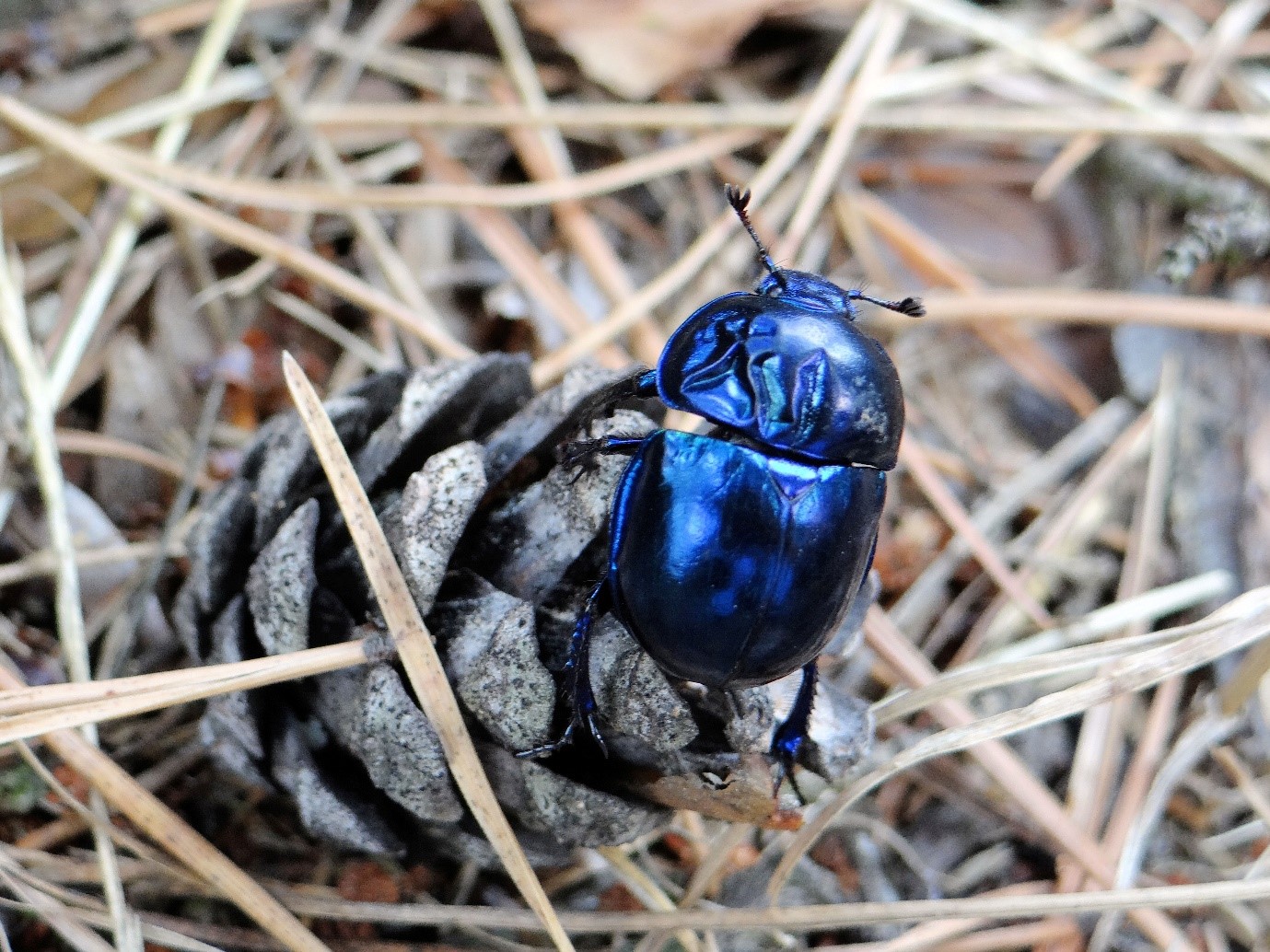
Dung beetles are a crucial part of the United Kingdom’s ecology and are responsible for the breakdown and decomposition of dung from all the major farm livestock species. Dung beetles help to fertilise the land and aerate the soil. It is estimated that in the cattle industry alone dung beetles contribute £367 million per year.
In the UK we have over 50 distinct species of dung beetle. British dung beetles are divided into two Families, Geotrupidae and Scarabaeidae. The Geotrupidae include Geotrupes (Dor beetles) and Typhaeus, (the Minotaur beetle). Scarabaeidae includes Onthophagus and the aphodiines, the latter group represent the most abundant dung beetles in the UK.
To understand just how important dung beetles are we need to assess the impact livestock dung could have on the landscape if we didn’t have dung beetles to break it down. For example, an average cow will produce 9 tons of dung per year, if this was not broken down then based on average cattle numbers in England this volume of dung would cover ~162,000 hectares of land, larger than the area of London! The same is true for sheep which produce just under 1 ton of dung per year per animal and horses produce 6.5 tons per animal per year.

Figure 1: Benefits of the dung beetle (The Bug Farm)
There are a number of issues arising with the overuse of anthelmintics and parasiticides within the livestock industry including resistance emergence and ecological damage caused by the residual chemicals present in the livestock dung. The most commonly used anthelmintics are macrocyclic lactones. Macrocyclic lactones are subdivided into two types, avermectins and milbemycins. Ivermectin, eprinomectin, doramectin are some of the common avermectins and moxidectin a milbemycin. All members of the avermectin group have a unique pharmacophore consisting of a 16-membered macrocyclic lactone backbone with a disaccharide chain at position C-13. The milbemycins are structurally similar to avermectins but differ in a few of the side chains at the C-13 position and are considered to be deglycosylated avermectins (Sangster and Dobson 2002; Vercruysse and Rew 2002).
Residues of macrocyclic lactones can have both lethal and sub-lethal effects on the dung beetles and the reduction in dung removal rate has been well studied and confirmed. However more recent research looks at the immediate and long-term effects of a decreasing dung beetle population. A study conducted in 2017 identified that although macrocyclic lactone exposure can have lethal effects to adult beetle populations at the point of contact dung removal rates were less severely impacted once the beetles had been initially exposed to macrocyclic lactone residues. Other ecological functions carried out by dung beetles such as, soil aeration and soil fauna feeding were also not significantly impacted providing the beetles survived the initial point of contact with the residues. This 2017 study did not assess the impact of anthelmintic residues on multiple generations of dung beetle or at high concentrations. Although this study did not differentiate the different types of macrocyclic lactones, a review article in 2015 highlighted that avermectins cause significant damage to dung beetles whereas milbemycins were observed to cause no noticeable damage to the adult dung beetles or their progeny. It has been noted that when compared to the milbemycins, avermectins pass through the animal and into their dung in a largely unaltered, still active state (Jacobs and Scholtz, 2015).
Reducing the use of anthelmintics would be one simple way of reducing the impact on dung beetle populations, lowering the chances of resistance emerging and prevent unintended side effects. It is important to only treat animals when they need treating, this can be assessed using a faecal egg count (FEC) to look at the parasite burden within your animal or herd. Ridgeway Research offer a diagnostic service which includes a FEC service. If anthelmintics are needed then they must be used as indicated, underdosing increases the chance of resistance developing and may result in further treatment needed leading to more residues present on the pasture. It is also important to keep newly treated animals off new pasture for at least a week following treatment, this allows most of the residues to pass through the animal and into their dung, this is tricky as some treatments are long-acting and will still be present in high concentrations in the dung for many weeks after treatment.
The take home message is that dung beetles are a critical part of the UK’s landscape and that effective parasite control is needed to prevent a decline in their numbers. It is a good idea to have a parasite control plan in place and regularly perform FECs to assess the health of your animals.
References:
British Equine Veterinary Association. (2023) Anthelmintics and dung beetles. Available from: https://www.beva.org.uk/Home/News-and-Views/Latest-News/Details/Anthelmintics-and-dung-beetles. [Accessed: 08MAR23]
The Bug Farm. (2018) Dung Beetles Direct. Available from: https://www.thebugfarm.co.uk/research-farm/dung-beetles-direct. [Accessed: 08MAR23]
Manning, P., Beynon, S.A., and Lewis, O.T. (2017) Quantifying immediate and delayed effects of anthelmintic exposure on ecosystem functioning supported by a common dung beetle species. PLoS One. 12(8)
Sangster N.C. and Dobson R.J., 2002, ‘Anthelmintic resistance’, in Lee D.L. (ed.), The biology of nematodes, pp. 531–567, Taylor & Francis, London.
Vercruysse J. and Rew R. (eds.), 2002, Macrocyclic lactones in antiparasitic therapy, CABI Publishing, Wallingford.